
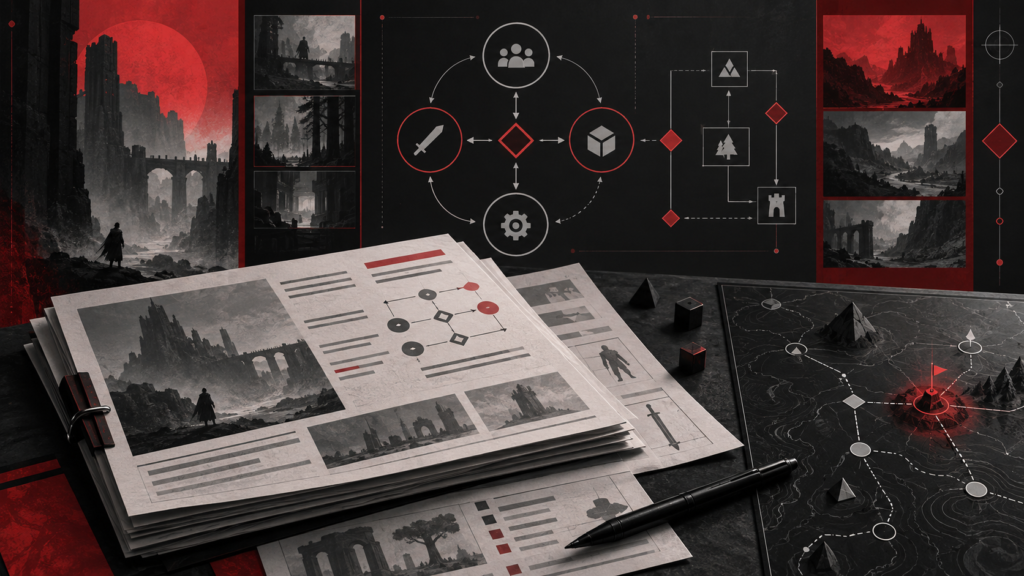
A Game Design Document is useful when it preserves decisions, assumptions, risks, and validation methods. Its value comes from helping design, engineering, QA, and production build the same game—not from its page count.
A small team usually needs a compact, living GDD rather than a giant specification. The document should be detailed enough to resolve repeated questions, but focused enough that people still read and update it. If the playable build and the document disagree, one of them must change.
Free tool: Open the QUBU GDD Builder and use the structure for your own project.
What should a GDD include?
- The player promise.
- The core gameplay loop.
- Main decisions and risk–reward structure.
- Progression.
- Economy sources, sinks, and limits.
- Content structure.
- Controls and interface states.
- Save data, online behavior, and technical constraints.
- Analytics questions.
- QA risks.
Start with the player promise
Before listing features, write one paragraph that answers four questions: Who is the player? What do they repeatedly do? Under what pressure do they make decisions? What should they feel when the system works? If this paragraph is unclear, the rest of the document often becomes a catalogue of unrelated mechanics.
Describe the core loop with verbs
A sequence such as “observe → choose → spend → see the result → recover” reveals the actual structure of play. It also gives onboarding, interface, analytics, and QA a shared reference. Each verb should have a visible player action and a readable response. If a step exists only in the document, it may not exist for the player.
Record the reason behind every important rule
“The cooldown is 12 hours” will lose meaning when the number changes. “The cooldown is 12 hours so ownership cannot change several times overnight” preserves the design goal. Numbers are adjustable; the reason lets the team judge whether a new number still protects the intended behavior.
Do not hide technical constraints at the end
Save migration, server authority, offline behavior, low-end hardware, input devices, and platform SDK requirements can change design. When a constraint affects what the player can do or understand, it belongs in the relevant system section. Keeping it separate as an engineering note makes conflicts appear late, when they cost more to fix.
A reusable GDD structure
- Game summary
- Player promise
- Audience and platforms
- Core loop
- Controls and camera
- Progression
- Economy
- Combat or interaction rules
- Content structure
- Interface states
- Save and online architecture
- Analytics questions
- QA risks
- Success measures
- Open questions
Use decision records to keep the document actionable
For each critical system, add four short fields: purpose, assumption, accepted risk, and validation method. A statement such as “a siege lasts 18 hours” is incomplete. The purpose may be to give defenders time to respond; the assumption may be that a counterattack remains possible; the accepted risk may be slower pacing. Validation can use match abandonment, return behavior, and playtest feedback.
This format preserves why a decision was made when team members change. QA can identify the behavior to test, analytics can connect events to a product question, and production can see when the decision needs another review.
Turn feature lists into decision tables
| Decision | Player effect | Risk | Validation |
|---|---|---|---|
| Sieges last 18 hours | Players have time to respond | Pacing may slow down | Abandonment and return rate |
| Storage is limited | Spending decisions matter | New players may feel blocked | First-week overflow data |
| Battle results are delayed | Asynchronous tension remains | Feedback may arrive too late | Return to the result screen |
A decision table explains what a feature is trying to do. When a number changes, the team can still protect the expected player effect rather than treating the old value as permanent truth.
A filled mini example
Player promise
The player chooses regions and positions armies with limited information, then earns a lasting strategic advantage by reading risk correctly.
Core loop
Read the map → choose a target → spend resources → observe the counterplay → evaluate the outcome → form the next plan.
Open question
Can a new player understand the difference between attack and defense during the first three turns? Tutorial completion, first-match abandonment, and moderated playtest notes should be read together.
Assign ownership across the team
The GDD should have one accountable owner, but it should not represent one person’s viewpoint. Design maintains the player promise and system rules. Engineering maintains dependencies and performance limits. QA records failure states and risky interactions. Production tracks scope and schedule impact. Add an owner and last verification date to each major section so outdated decisions are not mistaken for current rules.
Three common GDD failures
The first is writing marketing language instead of operational rules. A GDD should explain how a feature behaves and where it can fail. The second is formatting ideas, assumptions, and approved decisions in the same way. Mark them clearly so the team knows what can still change. The third is letting the document drift away from the game. After a major system change, review the relevant section beside the working build.
How often should a GDD be updated?
Update it when a decision, assumption, interface between systems, or validation plan changes. Do not rewrite every sentence after every meeting. A useful document changes at the speed of meaningful decisions: slower than casual discussion, but fast enough to match the build.
The new team member test
Give one system section to a teammate who does not know the project. If they can identify the rule, player feedback, failure condition, responsible person, and test method from the document, the section is working. If they need a long verbal explanation, the solution is clearer decisions in the right place rather than more pages.
Pre-production GDD checklist
- Is the one-sentence player promise testable?
- Does every core-loop verb have visible player feedback?
- Are economy sources, sinks, and limiting mechanisms explicit?
- Do save, online, and failure states match the design rules?
- Does every open question have a next validation step?
- Can the team trace each major rule to its purpose?
Conclusion
A strong GDD reduces uncertainty. It gives design, engineering, QA, and production the same answer when they inspect a system. Keep the player promise clear, record the reason behind rules, separate open questions from decisions, and connect every major risk to a validation method.
Continue with the main guides in the same content cluster.