
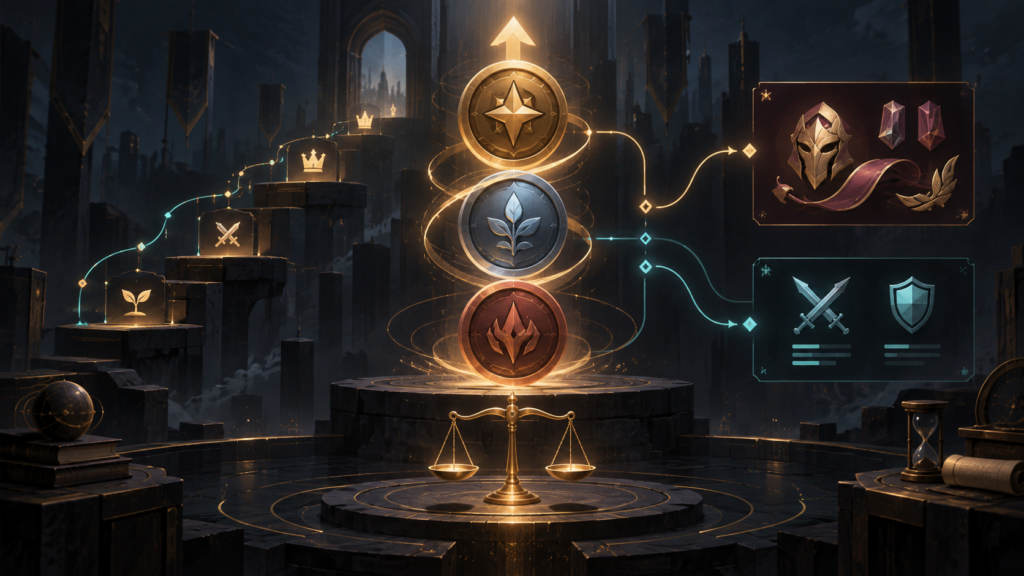
The nostalgic value of runes comes from experimentation, not from recreating a long power grind. Modern progression must preserve discovery while preventing access time or spending from becoming competitive power.
League of Legends Classic arrives with the obvious attractions: the older Rift, early items, familiar models, and mechanics many players have spent years describing from memory. The more useful design story sits underneath those images. The nostalgic value of runes comes from experimentation, not from recreating a long power grind. Modern progression must preserve discovery while preventing access time or spending from becoming competitive power. This article examines power access, learning sequence, and economic trust and asks not only what returned, but why it was packaged this way and how a live team can tell whether the reconstruction is working.
Modern infrastructure, matchmaking improvements, current pings, spell buffering, and optional WASD controls sit underneath the nostalgic ruleset. Riot built Classic as a “greatest hits” collection anchored in Season 3 rather than freezing one historical patch. Read together, those choices make it clear that Classic is not an archival executable. Riot is rebuilding a decision rhythm and a social memory inside the current client, infrastructure, and support expectations. Historical detail matters, but the stronger success criterion is whether a player finishes a match and can articulate why this ruleset asks them to think differently.
This analysis is grounded in Riot Games’ League Classic developer article, Patch 26.15 notes, and the official Classic page. Design conclusions are QUBU Games’ editorial and production analysis.
Portraits and era-themed cosmetics can carry nostalgia safely when competitive power remains quickly and clearly accessible. — Classic portrait artwork
Contents
- A nostalgic system carries modern obligations
- Defaults are a competitive safety net
- Classic Levels create a learning sequence
- Seasonal value needs a hard boundary
- Our QUBU takeaway
- Conclusion
- Frequently Asked Questions
A nostalgic system carries modern obligations
Modern infrastructure, matchmaking improvements, current pings, spell buffering, and optional WASD controls sit underneath the nostalgic ruleset. That detail turns a nostalgic system carries modern obligations from a nostalgic talking point into a product constraint. The system presents fewer but sharper options, so information order, feedback, and the cost of mistakes become easier to see. The test is not whether a returning player recognizes the reference. It is whether the game itself communicates the cause-and-effect chain well enough for the player to make the next decision.
One major risk is creating early power gaps. It will not appear in one clean number; rune-page completion needs to be read beside time spent on default pages. A team that combines make power access fast and legible with keep defaults safe but suboptimal can separate loud launch reactions from persistent system problems. Without that structure, a highly visible request can be mistaken for representative product evidence.
Defaults are a competitive safety net
The useful way to approach defaults are a competitive safety net is as a decision chain rather than a feature bullet. Riot built Classic as a “greatest hits” collection anchored in Season 3 rather than freezing one historical patch. A player sees a state, chooses an action, the system resolves it, and the interface explains the result. If one link imitates the past while falling below current readability expectations, nostalgia becomes friction remarkably quickly.
We would not use time spent on default pages as an isolated target. A rising value can mean better choices, longer waits, a different cohort, or a new failure mode. The practical action is to keep defaults safe but suboptimal, then segment by version, region, experience, and party context. That turns turning rune pages into purchase pressure from an abstract argument into a manageable production risk.
Practical checkpoints
- Make power access fast and legible.
- Keep defaults safe but suboptimal.
- Separate power from cosmetic value.
Classic Levels create a learning sequence
Classic is unusually honest about classic levels create a learning sequence. Early League made the weight of decisions visible through friction; modern League removed some of that friction in favor of flow and accessibility. The launch roster contains 60 champions: the original 40 plus 20 hand-picked releases from 2009 to 2013. The new mode does not need to average the two philosophies. It needs to decide which friction creates meaning and which merely consumes attention.
The team should watch for letting defaults replace understanding. If performance before and after unlocks falls while rune-page completion rises, an apparently smoother flow may be creating a quality loss elsewhere. Our recommendation is to separate power from cosmetic value, while assigning an owner, default state, observation window, and rollback condition to the control itself.
Seasonal value needs a hard boundary
From a live-product perspective, seasonal value needs a hard boundary also defines a production boundary. Design, client, server, data, QA, support, and communication all carry different faces of the same rule. Classic brings together early items, runes, masteries, the older Summoner’s Rift, and many pre-rework champion kits. “The feature works” is therefore not a sufficient acceptance criterion; reconnects, duplicate requests, partial service failure, legacy states, and recovery behavior belong in the definition.
Operationally, the first step is to cap seasonal acceleration. The team then needs a normal range, alert threshold, and decision owner for season-track participation. When allowing seasonal rewards to distort the core economy remains uncontrolled, reducing scope or staging exposure is release discipline, not failure. Players never see the runbook, but they feel its quality in every consistent transition.
Our QUBU takeaway
Our conclusion is that power access, learning sequence, and economic trust is not one design decision. It is the combined output of content selection, interface clarity, production capacity, and a shared measurement dictionary. In a product carrying this much expectation, the team should write the experience promise first and evaluate every feature against it.
A practical framework is straightforward: make power access fast and legible and keep defaults safe but suboptimal; separate power from cosmetic value and cap seasonal acceleration; set observation windows for rune-page completion and time spent on default pages; and assign the decision owner before a critical signal moves. This does not turn nostalgia into a sterile museum piece. It creates room for the old decisions to matter while preserving a modern standard of reliability.
Actionable conclusions
- Make power access fast and legible.
- Keep defaults safe but suboptimal.
- Separate power from cosmetic value.
- Cap seasonal acceleration.
Conclusion
On launch day, the easiest things to notice are the old images and names. The more valuable question is which behaviors those assets recreate. The nostalgic value of runes comes from experimentation, not from recreating a long power grind. Modern progression must preserve discovery while preventing access time or spending from becoming competitive power. Over the next weeks, success will be defined not only by how many people try the mode, but by how many understand it, return with friends, and trust the reasons behind its changes.
Frequently Asked Questions
Is League Classic one exact Season 3 patch?
No. Riot describes Season 3 as an anchor and combines selected champions, systems, items, and mechanics from several early years.
Does League Classic run in the current League client?
Yes. Classic is delivered through the modern League of Legends client and infrastructure as a separate gameplay experience.
How current is the information in this article?
Launch features and dates were checked against Riot’s official pages and Patch 26.15 notes on 29 July 2026.
Sources and external links
- Riot Games — /dev: League of Legends Classic
- Riot Games — Patch 26.15 Notes
- Riot Games — League of Legends Classic
- Riot Games — TL;DW: Classic, Mayhem & More
- Unity LiveOps documentation